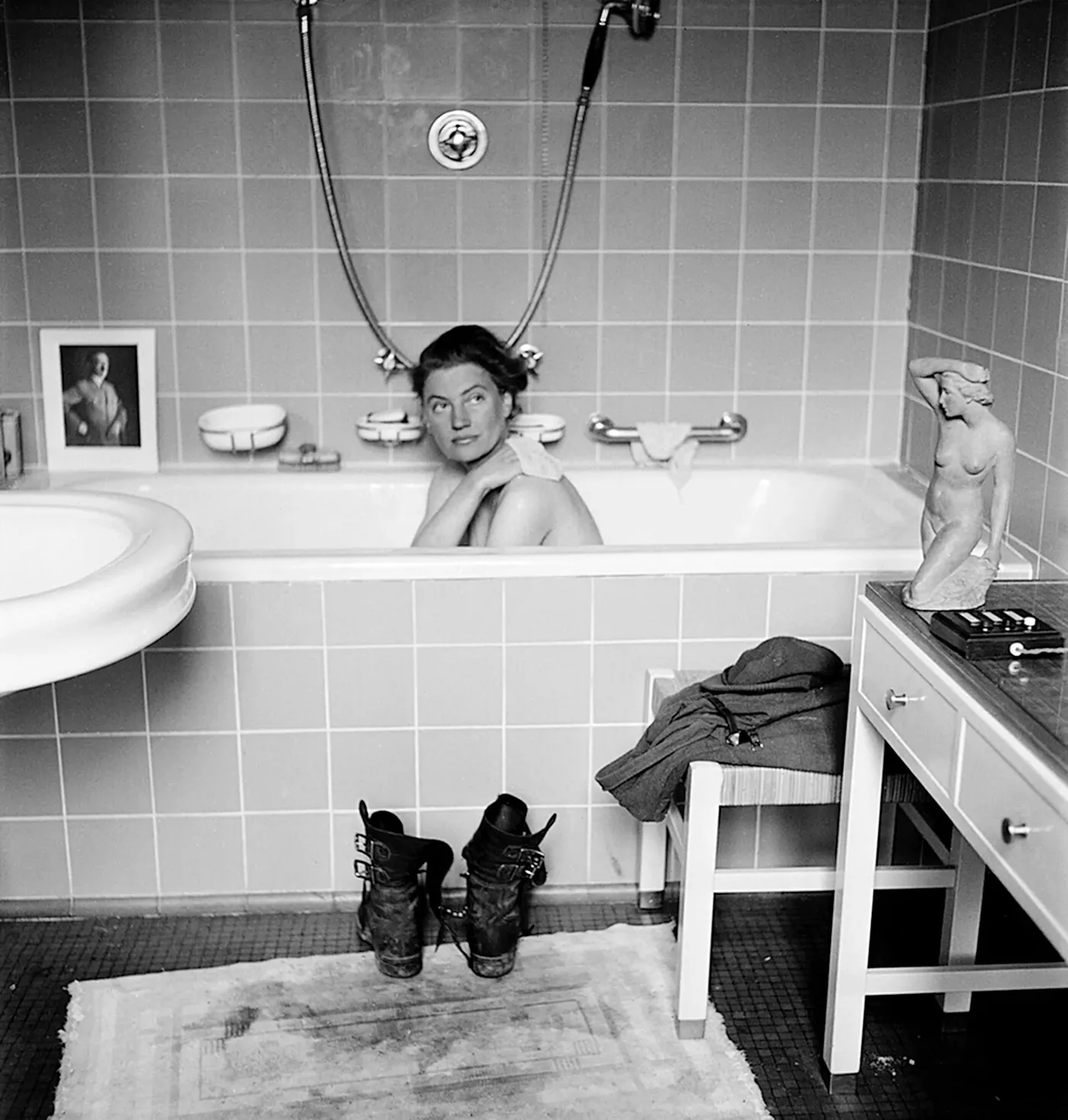
It was 30 April 1945. Munich was quiet, the kind of quiet that lingers when a war is almost over but no one knows it for certain yet.
A few hours earlier, a woman in military uniform had walked through Dachau. The camp had been liberated just the day before. The train cars were still full. The survivors looked like shadows. She carried a camera and took photographs, because someone had to capture it. Otherwise, the world wouldn’t believe it.
Her name was Lee Miller. She had once been a model on the covers of Vogue. Later, she became muse and student to Man Ray in Paris, among the surrealists. Now she was a war correspondent, one of the few women at the front.
That afternoon, along with Life photographer David Scherman, she arrived at a building on Prinzregentenplatz 16. It was Hitler’s apartment. The Americans had requisitioned it. His clothes still hung in the closets, and his books remained on the shelves.
Lee stepped into the bathroom. She filled the tub. She took off her boots, caked with dirt from Dachau, and left them deliberately on the pristine white bathmat. She propped a portrait of the Führer on the edge of the tub. Then she climbed into the water, and Scherman pressed the shutter.
She wasn’t smiling. She wasn’t celebrating. She was simply washing, as if to say the dirt of the dead was being returned.
That night, hundreds of kilometers away, in a bunker beneath Berlin, the man who had made this bathtub his own had already taken his own life. No one in Munich knew yet.
Lee returned to England. She never again picked up a camera seriously. What she had seen haunted her for years. She died in 1977. After her death, her son climbed into the attic and found thousands of negatives, an entire life hidden in boxes.
Inside one of those boxes was this very photograph.